Export to C3D format
Click Export on the File menu and then To C3D to export to the C3D format. The C3D format is a motion capture industry file format. It supports simultaneous storage of motion data, analog data and other data types in the same file.
C3D data can be exported even if the file does not contain any 3D data. For example if you have measured forces or EMG.
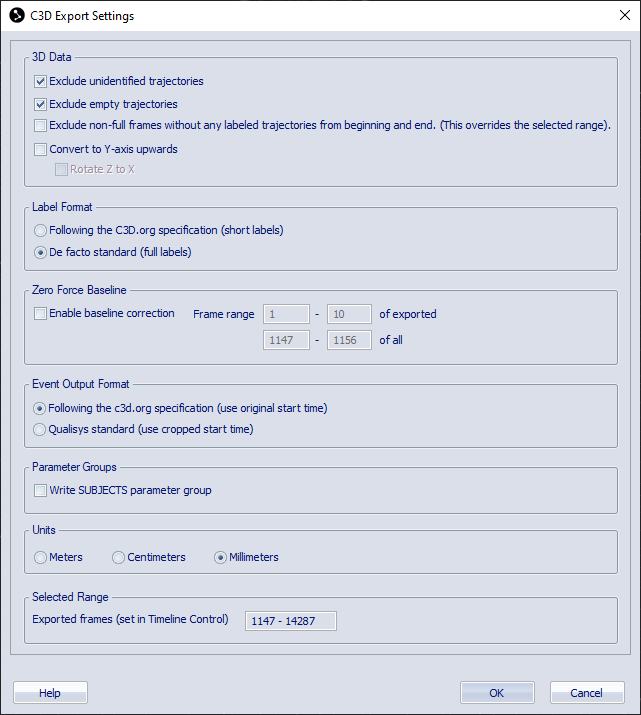
For information about the settings see chapter C3D export. The frames that are included in the export are shown under the Selected Range heading. The range is set by the measurement range on the Timeline control bar.
The Zero Force Baseline option is only used on force data and its frames are set in relation to the exported range. However the range is also displayed in relation to all frames. Make sure that the force plates are unloaded during the frames that are used for correction. Otherwise the data will be wrong in for example Visual3D.
C3D file format
The C3D export creates a C3D file, for information about the binary C3D format see http://www.c3d.org.
The C3D format has the following limitations for analog data:
- The analog sampling frequency must be an integer multiple of the capture rate.
- All analog channels must use the same sampling frequency.
If the analog data stored in the QTM file does not meet these requirements, the data will be resampled to the lowest integer multiple of the capture rate that is greater than or equal to the highest analog channel frequency. For example, if the marker frequency is 120 Hz, the EMG frequency is 1500 Hz, and another analog channel uses a frequency of 1200 Hz, all analog data will be resampled to 1560 Hz. Resampling is performed using linear interpolation.
Multiple subjects can be included in a C3D file. For more information, see chapter Parameter Groups.